
Our next guest speaker is James Middleton (hopefully with Tom Marriott) and you’ll be able to listen to him at St Thomas’ (The Suite), Brampton on Wednesday 20 May, 6.30 for 7pm start
Historic property rescuers and lifelong friends James Middleton and Tom Marriott are giving back to their home town of Chesterfield by regenerating neglected buildings.
Their hard graft and tender loving care ensure that properties which have fallen into disrepair are sympathetically renovated and repurposed.
James said: “We’re taking buildings that are derelict, that nobody can see the potential in. Rather than knock them down or turn them into flats, we’ve turned them into hybrid working spaces. We blend work and home life into the office space, they’ve got showers, they’ve got toilets, they’ve got decent kitchens.”
Regenerating Chesterfield one building at a time, their latest acquisition is the 18th century Cannon Mill in Brampton which was bought for £130,000. The building has been empty for 69 years.
Cannon Mill started operating in 1775, and was used for boring and casting cannons, cannonballs and other armaments. James said: “It must have made munitions for the Napoleonic War and the Battle of Waterloo.”
Tom said: “We found a book, written by the Robinson family, with a historic drawing of the site which showed it was about four times the size of what it is now.”
The mill’s centuries-old iron waterwheel will remain as a symbol of Derbyshire’s heritage under James and Tom’s vision to renovate the building into a hybrid working space. They estimate that the conversion, which is subject to necessary permissions from heritage and planning authorities, will take a year. Developments with this project will be posted on YouTube.
James, 35, is managing director of structural steelwork specialists Middleton Structures and property business White Olive Holdings. His right-hand man Tom, 37, is operations director and has a background in the builders merchants industry.
James, 35, is managing director of structural steelwork specialists Middleton Structures and property business White Olive Holdings. His right-hand man Tom, 37, is operations director and has a background in the builders merchants industry.
Previously used as a van rental office, the old chapel had been empty for eight years following its purchase by Lidl as part of a large site to build its supermarket. Planning constraints meant that the last remnant of the Congregational Church could not be demolished. James said: “There was a sign saying ‘lease opportunity’ and I kept walking past the building feeling sorry for it.” He contacted the estate agent and was told that they were struggling to find a tenant for it and that the property would be going up for sale.
James said: “When I went to look at it, it was flooded with a foot of sewage, there were dead birds, asbestos, the roof was leaking – everything you would not want in a building.”
But with a vision of the “ugly duckling” property becoming a beautiful swan of a building, he bought it for £125,000. A team of locally based, experienced tradesmen spent six months working on the transformation.
James said: “We shelled it. We took the roof off because it was rotten.” Traditional slates was used in the re-roofing, original timber trusses restored and solar panels installed. On the upper floor, the interior walls were covered in timber and shiplap secured to the ceiing. James said: “These buildings do twist and move with the heat so if you have plasterboard it will crack and the plaster will come out.”
A plaque inscribed with the name S Manlove was discovered while demolishing an extension, which had been poorly constructed and was a later addition to the 19th century property. Research found that Simeon Manlove constructed the chapel as a Sunday School in 1874, owned a cotton mill at Holymoorside and also built the village school there.
James and Tom, who both went to Holymoorside school and have been friends since childhood, have credited Simeon by renaming the old chapel Manlove House and preserving the plaque. Tom said: “That’s a big part of what we do – we want to honour everything that the building’s gone through and sympathetically do everything for it.”
James said: “What you find with old chapels is because they were built for a purpose, ie to praise the Lord, they were built with pride. So when we’ve come back 150 years later and we’ve set up our instrument to survey these buildings, they are pretty much level; they are square, they are honest, they are reliable.
“When you take on these old buildings, they just want some TLC. In the Sixties, Seventies and Eighties they’ve been bastardised by rogue workmanship and poor repairs. You strip all the layers of the onion off, there’s a few tears along the way but when you get back to the core and you put it back together, the buildings love what we’ve done.”
The ground floor now offers a large storage space, washing and wc facilities. To one side of the property is a stretch of the River Hipper which the former chapel’s guardians ensure is meticulously and regularly cleared of debris.
It’s the second chapel in Chesterfield which has been given a new lease of life. James said: “In March 2023 we bought an old coach house on Catherine Street for £150,000 and at the rear of it was a chapel. We did a sympathetic restoration on it, we shotblasted all the walls, put steelwork in there, block paved the floor.”
Stripping out the former Church of the Nazarene uncovered a big timber frame with a glass door decorated with a picture of Jesus on the cross and all the people who had been christened there until 1984. That was preserved in the renovation as was one of the abandoned pews which is now in the office of Middleton Structures which has been based at Catherine Street since the conversion.
James’ first renovation project was a chapel in Mansfield Woodhouse in 2018. He said: “We were looking for our own premises and we couldn’t really find anything. I ended up looking at a car park on Rightmove and I thought it would be great to store some vans, materials and put a cabin in there. I didn’t realise that the car park came with a derelict chapel – it had been on the market for three or four years.
“I ended up buying an old chapel that had been empty since the Sixties and was in really bad shape. Because we fabricate steel, we made our own walkways, made our own lighting frames and strengthened the building. At the back we had surplus requirement and we rented it out as office space. Next door to that was some derelict land. As the business grew and we became more profitable, we built our own industrial estate with four units in 2019/2020.”
Other renovation projects have included transforming a redundant commercial garage on Smith Road, Matlock into an eco home. In front of that property was a former slaughterhouse which was converted into office accommodation.
A former motoring supplies shop on Chesterfield Road, Mansfield became a hybrid working space after being rewired, reroofed and thermally upgraded in 2025.
James, who grew up in Chesterfield and founded his business in Milton Keynes, moved back to town five years ago. He bought Walton Ridge on Matlock Road and extensively renovated the property to transform it into his family home. James said: “What is ironic is that I’m an engineer by trade and Walton Ridge was built by Harry Brearley who invented stainless steel.”
The success of his business has enabled the purchase of Walton Wood – not for financial gain but to improve its look. James said: “When I used to walk from the house to the petrol station for sweets for the kids, the wall was overgrown with ivy and collapsing. There was asbestos in the woods, a couple of car tyres dumped there, vandals were in there – it was a mess. We bought the land, cleaned all the vegetation, planted wildflowers and rebuilt the wall.” A seat was also built so elderly people had somewhere to rest while waiting at the bus stop.
Neither James or Tom are from wealthy backgrounds; James commented: “We’ve had nothing…that is why we’ve worked and worked and worked.”
James was unable to hear until the age of three when he had grommets fitted, followed by speech therapy. Dyslexia has affected his ability to read and write. “At school I was written off,” said James. “I got offered an apprenticeship as a trainee engineer when I was 16.”
He left Chesterfield and set up as a freelance project engineer, launching his company in Milton Keynes when he was 22. James said: “In 2017 I went for it and grew the business exponentially. I borrowed as much money as I could and worked as many hours as I could. From 2017 and a standing start, we did just under £1.6million turnover in our first year.
“We’ve built up a reputation within the construction industry as a technical steelwork specialist. We’ve done work for the National Trust, Bolsover Castle and Oxburgh Hall in Norfolk as part of the heritage rescue with Nick Knowles. We do an awful lot of work for Marks and Spencer, Morrisons and Asda.
“We’re now doing just over £5million a year turnover. We had a record January, we turned over £745,000.
“We employ an exceptional, highly skilled motivated workforce of 24, made up of employees and sub contractors. We’ve got a really great team, all long-standing.”
But it’s not all been plain sailing for his structural steel business. James said: “Two years ago, clients went into administration on me and I lost a quarter of a million quid. Everybody else would have shut the business – but we didn’t. I sold my classic car collection, my toys, to put back into the business, to go again.”
Exciting projects are in the pipeline for the property renovation side of the operation. “We’ve got a lot of cash to find and we’ve got to keep the business running,” said James. “At the moment, we’ve not borrowed a penny. We’ve generated and put back in.”
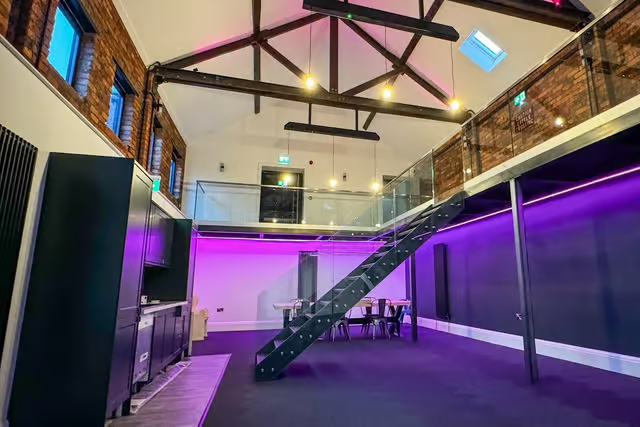
Below: stunning office space created from a former church
